Extreme event analysis using quantile regression
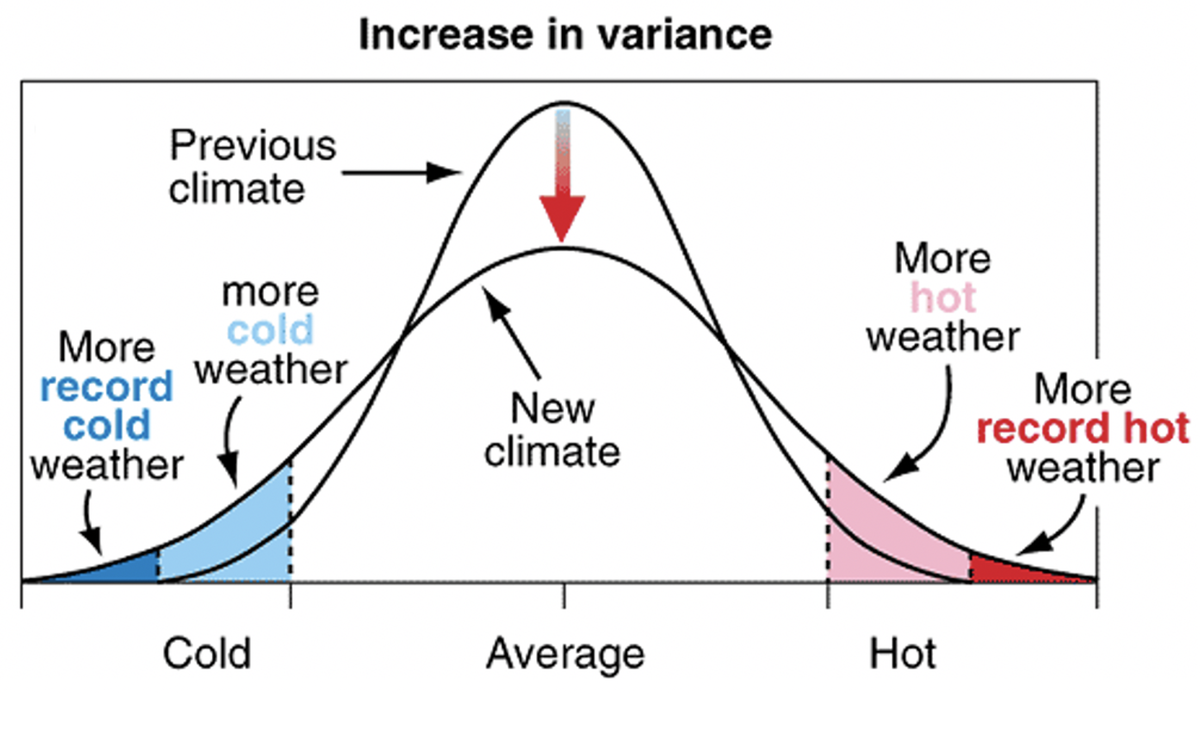 What do you do when variability increases, but the mean remains unchanged? Typical regression techniques would miss the shifts! Image credit: IPCC
Climate change will increase the frequency and severity of extreme events. Unfortunately, modeling extreme events is hard. First, you need a lot of data. Second, most statistical models are not designed for extreme events. Third, those extreme event models that do exist have a high barrier to entry. Here I’ll discuss a model I have found very helpful in my research to tackle these challenges: quantile regression.
Why quantile regression?
- Flexibly explore different parts of the target distribution (e.g. the tails)
- Detect changes in mean, variability, and skew
- Utilize the full dataset
- Robust to outliers
- Easy implementation thanks to quantreg package in R
Most standard statistical methods are well suited to analyzing changes in the mean. But, what happens when there are changes in variability? The opening graphic above from the IPCC demonstrates one such use case of quantile regression. Standard linear regression would report no trend in the mean, from which you might assume there is no trend in extreme events, hugely underestimating your climate risk.
Detecting changes in distribution shapes
Let’s walk through a few examples of shifts in the shape of the distribution, what they mean for extreme events, and how you would measure them with respect to different quantile trends.
Here I will consider trends in the 10th, 50th (median), and 90th percentiles. I have seen other applications use the 5th and 95th percentiles instead, which look at trends in even more rare events. My word of caution is that your dataset should increase in size as you explore more and more extreme quantiles.
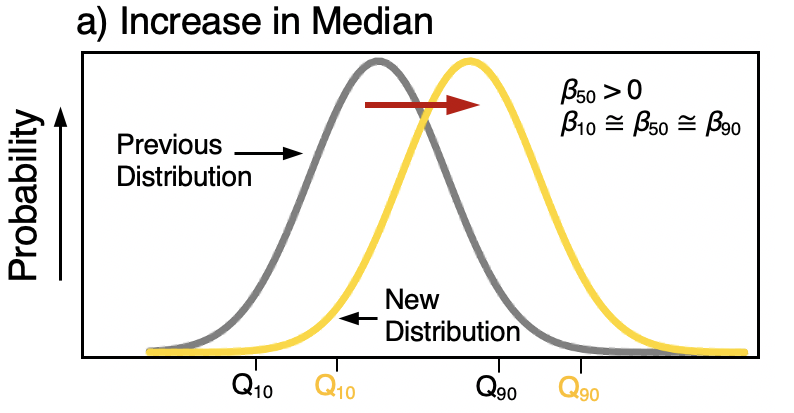
The first scenario is a simple shift in the mean/median (a). This is the default assumption of most trend analyses I have seen in climate sciences. For shifts towards warmer weather, this means more hot extremes and fewer cold extremes. The 10th, 50th, and 90th percentile trends are all positive and roughly equal to each other. Easy!
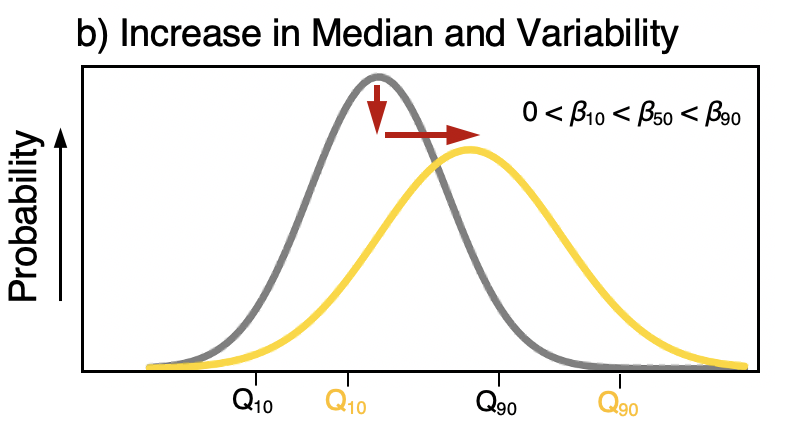
The second scenario portrays a shift in the median towards warmer conditions along with an increase in variability. This would be the worst case if we are considering temperatures, with an essentially completely new thermal regime. The new regime has a far greater likelihood of extreme warm temperatures. Here the 90th percentile trend exceeds the 50th, which itself exceeds the 10th.
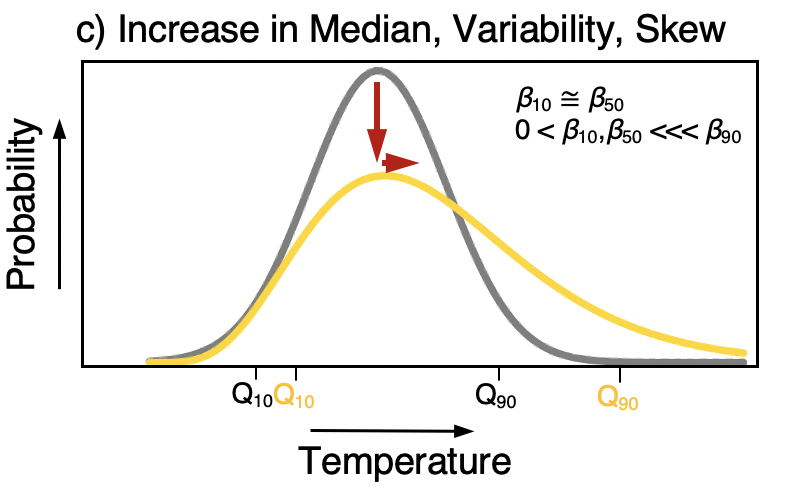
The third scenario portrays a shift in the median towards warmer conditions along with an increase in variability and a change in skew. Skewness can essentially be though of as a measure of distribution symmetry. Skewness is particularly relevant when the initial distributions are not normal, such as with precipitation and tropical cyclone (hurricane) speeds. In the scenario depicted above, subtle changes in the median belie massive increases in the risk of hot extremes. The expansion of variability here is driven primarily by increases in hot extremes.
Application to river temperatures
As part of my PhD, I was interested in how rivers and streams have already responded to climate change. I conducted a trend analysis using quantile regression at 149 rivers across the U.S. utilizing daily water temperature data provided by the U.S. Geological Survey.
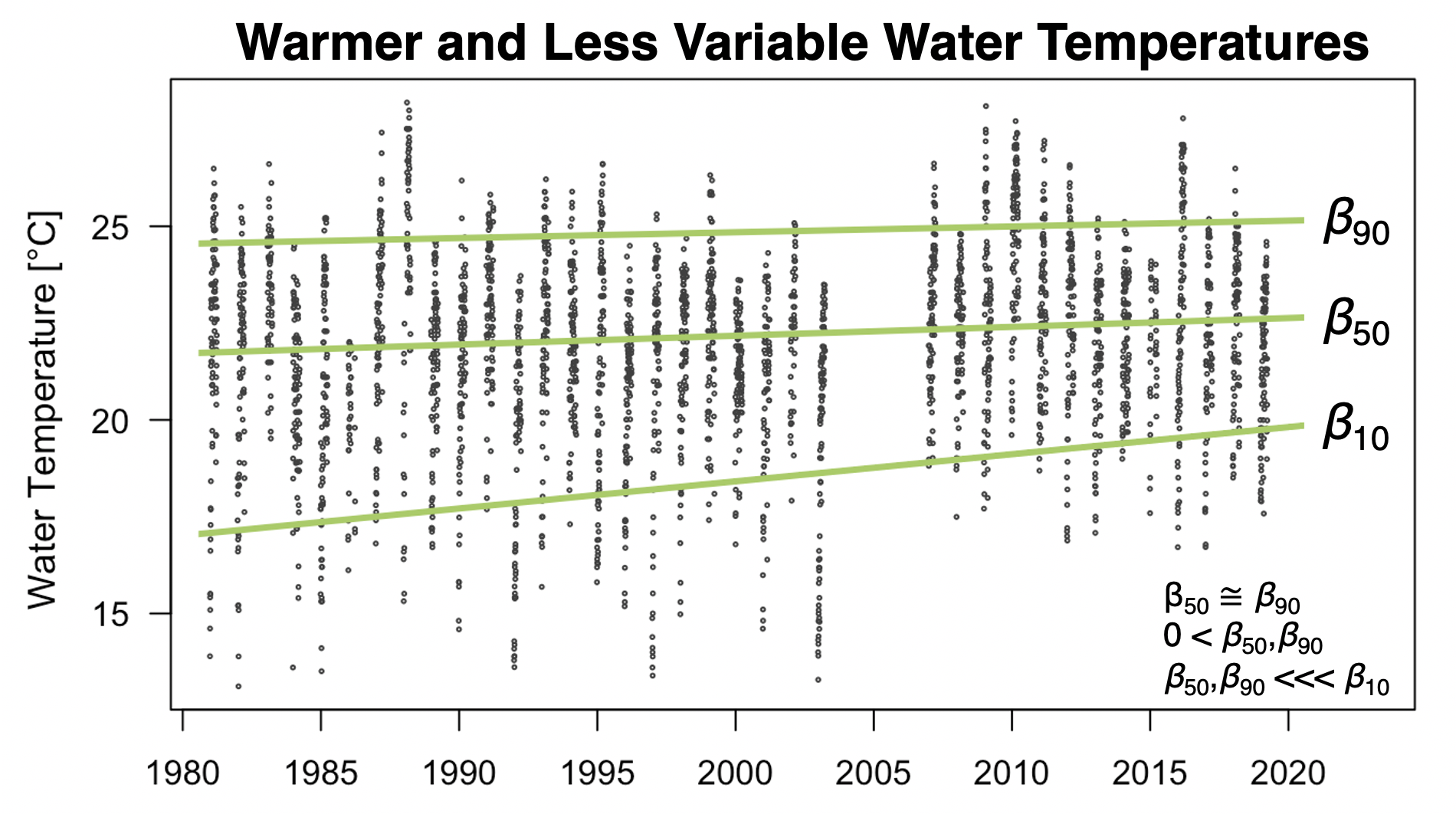
This river indicates a decrease in variability driven primarily by warming of the 10th percentiles, i.e. a decrease in cold extremes. Such an analysis provides a much more detailed picture of change in these systems than a typical linear regression. Moreover, we can pinpoint the driver of the changes in variability, something that methods like trends in standard deviation would fail to provide.
Summarizing across the U.S., briefly, we found that 84% of rivers have already experienced warming in median water temperatures, and 77% of rivers indicate a significant change in variability. Nearly half of U.S. rivers show warming of the 90th percentile during summer months, suggesting increasing risk from extreme heat events. Warming of median and extreme temperatures can have important ecological consequences, such as by altering habitat suitability and exceeding species’ thermal thresholds.
Final thoughts
I have found quantile regression tremendously useful in my work and look forward to its continued adoption in industry and academic research. I only scratched the surface in this post by demonstrating univariate quantile regression between temperature and time. As with linear regression, additional covariates can be incorporated to gain further insights into how different covariates interact to influence the response variable distribution and its extremes. A final caveat is that I did not touch on statistical significance testing of regression coefficients. The quantreg package provides several options, and I typically use their bootstrap approach, but these can be complicated when investigating time series trends in the presence of autocorrelation.